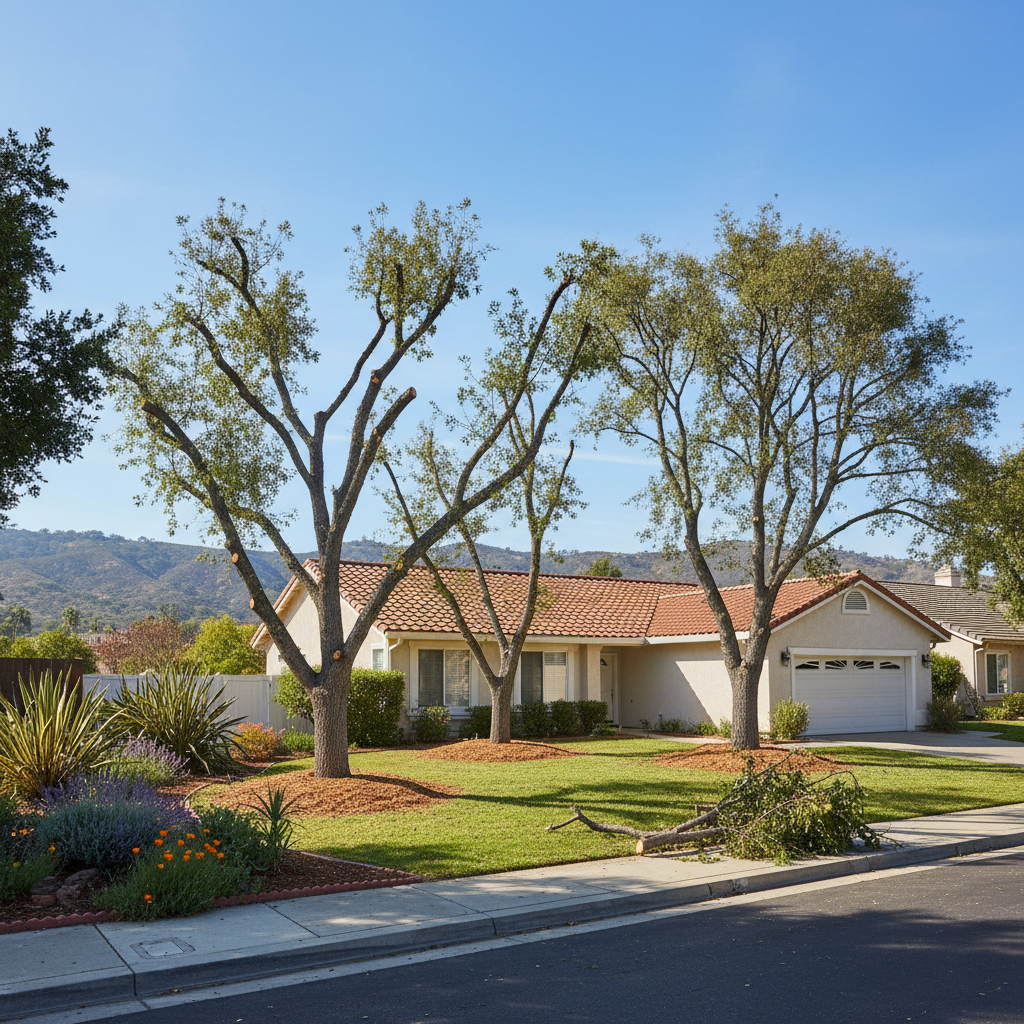
Alright, let's talk about tree pruning costs here in Aliso Viejo. It's one of those things where folks often call me up and say, "Just give me a number!" but it's rarely that simple. There's a lot that goes into it, and I want to give you the straight scoop so you know what to expect and how to avoid getting ripped off.
What Makes Pruning Costs Go Up or Down?
You can't just throw out a flat rate for tree pruning because every tree, every yard, and every job is different. Here's what I'm looking at when I give you a quote:
- Tree Size and Type: This is a big one. A small, young ornamental tree that's easy to reach is going to cost a lot less than a massive mature oak that's 50 feet tall. The bigger the tree, the more time, equipment, and crew members it takes. Some trees, like palms, require specialized tools and techniques, which can affect the price.
- Tree Health and Condition: If a tree is overgrown, neglected, or has a lot of dead or diseased branches, it's going to take more work. Sometimes we're dealing with branches that are already brittle and dangerous, which slows things down and requires extra caution.
- Access to the Tree: Can we get our equipment right up to the tree? Or is it tucked away in a tight backyard with narrow gates, requiring us to haul everything by hand? Easy access means less labor and a lower cost. If we have to work around pools, delicate landscaping, or power lines, that's going to add to the complexity and the price.
- Scope of Work: Are we just doing a light trim to remove a few small branches, or are we doing a major structural prune, crown reduction, or deadwood removal? The more extensive the work, the more it'll cost.
- Location of the Tree: Is it over your house? Over power lines? Near a busy street? Working in hazardous or high-risk areas means we need more safety measures, specialized rigging, and often a larger crew. This is especially true for homes built on some of Aliso Viejo's hillsides, where access can be tricky and the drop-off can be significant.
- Debris Removal: Most quotes include hauling away all the branches and wood chips. If you want to keep the wood for firewood or mulch, let us know – sometimes that can shave a little off the price, but usually, the cost of disposal is built-in.
Typical Cost Ranges in Aliso Viejo
Okay, I know you want some numbers. Keep in mind these are ranges, and your specific situation might fall outside them, but this should give you a good idea:
- Small Trees (under 20 feet): Think young fruit trees, smaller ornamental trees, or large shrubs. For a basic trim, you're usually looking at something in the range of $150 to $400. This is often a quick job, maybe an hour or two for one or two crew members.
- Medium Trees (20-40 feet): This covers a lot of common residential trees. For a good, thorough pruning, you're probably in the $400 to $900 range. This might involve a couple of hours for a small crew, possibly with some climbing or a lift.
- Large Trees (over 40 feet): Now we're talking about big, mature shade trees. These jobs are more complex, take longer, and often require specialized equipment like a bucket truck or extensive climbing and rigging. You can expect to pay anywhere from $900 to $2,500+. If it's a really massive tree, or if it's in a super tricky spot, it could even go higher.
- Palm Trees: Palm pruning is a bit different. Depending on the height and type of palm, you're generally looking at $80 to $250 per palm. If you have a whole row of them, sometimes we can offer a better per-palm rate.
Remember, these are for professional, insured, and licensed companies like Aliso Viejo Tree Service. Don't fall for the guy with a chainsaw and a pickup truck offering to do it for fifty bucks. You'll regret it when your tree is butchered or, worse, when someone gets hurt on your property.
What Should Be Included in a Quote?
When I give you a quote, here's what you should expect to see detailed:
- Specific Services: It should clearly state what kind of pruning is being done (e.g., deadwood removal, crown thinning, structural pruning, clearance from structures).
- Tree Identification: Which trees are being pruned? Sometimes it's just one, sometimes it's several.
- Debris Removal: Confirmation that all cut branches and debris will be removed from your property and disposed of properly.
- Cleanup: That the work area will be left clean and tidy.
- Insurance and Licensing: A reputable company will be happy to provide proof of liability insurance and workers' compensation insurance. Don't ever hire someone without these.
- Timeline: An estimated timeframe for when the work will be done.
A good quote isn't just a number; it's a clear understanding of the work being performed.
How to Avoid Overpaying for Tree Pruning
Nobody wants to pay more than they have to, right? Here's my advice:
- Get Multiple Quotes: Always get at least three quotes from different reputable companies. This helps you compare not just prices, but also the scope of work and the professionalism of the company.
- Be Specific About What You Want: Clearly communicate your goals. Do you want to remove dead branches? Lift the canopy for more light? Clear branches from your roof? The more specific you are, the more accurate the quotes will be.
- Don't Automatically Go for the Lowest Bid: The cheapest option isn't always the best. If one quote is significantly lower than the others, there might be a reason. They might be cutting corners, not properly insured, or planning to do a rush job. Quality work from a reputable company is an investment.
- Ask for Proof of Insurance and Licensing: I can't stress this enough. If they can't provide it, walk away. It protects you from liability if something goes wrong.
- Check References and Reviews: See what other Aliso Viejo residents are saying about them. Online reviews (Yelp, Google, Nextdoor) are a good starting point.
- Consider Regular Maintenance: Proactive, regular pruning is often cheaper in the long run than waiting until your trees are overgrown and require extensive, costly work. Small, routine trims prevent big, expensive problems.
Pruning is essential for the health and safety of your trees and your property. Don't put it off, but do your homework. A little research upfront can save you a lot of headache and money down the line.